
[ad_1]

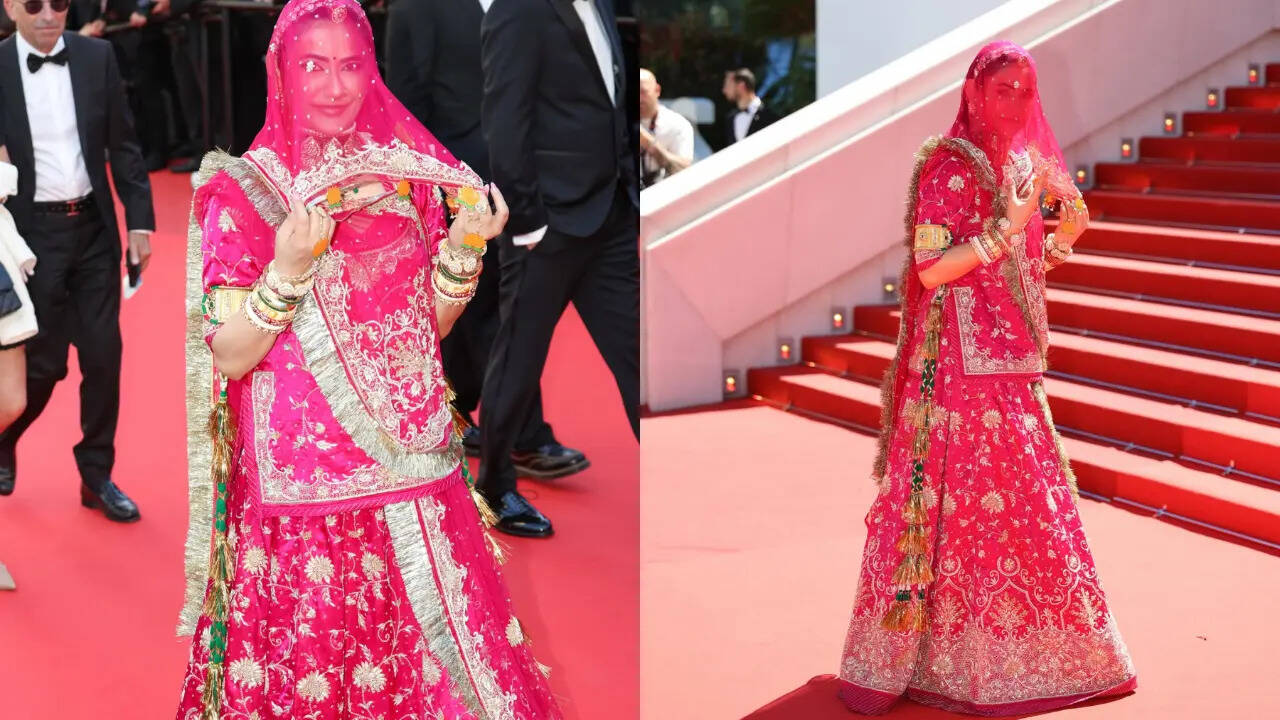
The Cannes Film Festival red carpet usually runs on sparkle, dramatic gowns, and celebrities trying to outdo each other with bigger fashion moments every year. But this time, Ruchi Gujjar showed up and took the conversation in a completely different direction.Instead of wearing a typical glamorous Cannes outfit, Ruchi walked the red carpet in a traditional Rajputi poshak and covered her face with a ghunghat. Naturally, people online noticed immediately.And honestly, it wasn’t just the outfit that got attention, it was the message behind it too.Sharing photos of her look, Ruchi wrote, “My ghunghat is a symbol of respect, my pride, but never a sentence of my silence.”That one line alone was enough to spark a huge debate online.
Her look felt deeply traditional – Which is exactly why it stood out
For Cannes, Ruchi leaned fully into Rajasthani tradition. The Rajputi outfit featured detailed work and was paired with heavy silver jewellery that gave the whole look a very regal, old-school feel.But obviously, the ghunghat became the biggest talking point.At a place like Cannes, where red carpet beauty looks are everything, covering your face with a veil instantly grabs attention. Most celebrities are trying to make sure every angle of their makeup and styling is visible, so Ruchi’s choice felt unexpected.Some people loved that she brought a traditional Indian look to such a massive global platform. Others questioned whether symbols like the ghunghat should still be celebrated today.And that’s exactly why the look blew up online – people had very different reactions to it.
The ghunghat has always been a complicated topic
The ghunghat has existed in many Indian communities for generations, especially in places like Rajasthan, Haryana, and Uttar Pradesh. Traditionally, married women wear it as a mark of modesty and respect, sometimes covering just the head and sometimes the entire face.For some families, it’s simply seen as culture and tradition.
But over time, the practice has also become tied to conversations around patriarchy, women’s freedom, and social pressure. A lot of people see it as restrictive, while others continue to view it as part of their identity and heritage.That’s why Ruchi’s Cannes appearance felt bigger than just another fashion moment.By saying her ghunghat represents pride but not silence, she seemed to be reclaiming the symbol in her own way. And social media had a lot to say about that.
Even Bollywood has been talking about the ghunghat recently
Interestingly, this isn’t the first time the ghunghat has become part of a larger conversation in pop culture.The topic recently came back into focus with Laapataa Ladies, directed by Kiran Rao. The film used the ghunghat as a major part of the story, where two brides accidentally get exchanged because their faces are hidden beneath veils.The movie mixed comedy with social commentary and ended up starting conversations around identity, tradition, and how women are often expected to “adjust” within society.Even outside films, the discussion around ghunghat has become more public over the years. Back in 2020, Rajasthan even launched a campaign called “Ghoonghat Mukt Jaipur,” which aimed to discourage the practice as part of broader conversations around women’s empowerment.So when Ruchi appeared at Cannes in a ghunghat, people didn’t see it as just a fashion choice. They immediately connected it to these bigger cultural debates.
Fashion, symbolism, and social media all collided here
What made this moment so interesting is that it sat somewhere between fashion and social commentary.At Cannes, fashion is rarely just about clothes anymore. Celebrities use outfits to make statements all the time — sometimes political, sometimes personal, sometimes cultural.And Ruchi’s look definitely felt intentional.The silver jewellery, the traditional silhouette, the veil — everything about it was designed to make people stop and think. Whether people agreed with the symbolism or not, the look managed to do exactly what fashion at events like Cannes often aims to do: start a conversation.And honestly, in the middle of endless glittery gowns and predictable red carpet looks, this was probably one of the most talked-about Indian appearances for a reason.
Indian fashion at Cannes is becoming more personal
One thing this year’s Cannes red carpet has made very clear is that Indian celebrities and creators are no longer trying to fit into just one version of global fashion.Some are bringing sarees, some are highlighting regional textiles, and others are using fashion to talk about identity, heritage, or social issues.Ruchi Gujjar’s appearance fit right into that shift.Because whether people loved the look or debated it, nobody ignored it.And maybe that’s what made it memorable in the first place.
[ad_2]
Source link